14th April 2025
Last updated: 8 May 2026 · By Luke Lv, Director, Lumira Studio
The first 8 seconds of a video determine whether the viewer commits to watching the rest. This is not opinion; it is observable in retention data across every major platform. Most weak-performing video is not weak in execution. It is weak in the opening, and the rest of the video never gets a chance. The disciplines that produce strong opens are repeatable.
Why 8 seconds matters
Three observable patterns in video retention data:
- The biggest single drop-off in any video happens in the first 5-10 seconds. If the viewer does not see something compelling fast, they leave.
- Algorithms reward retention through this window. YouTube, Meta, TikTok, LinkedIn all weight early retention heavily. Weak opens cost ranking.
- Even committed viewers form judgement fast. A weak open trains the viewer to half-watch the rest, even if they do not click away.
The 8-second threshold is not arbitrary. It is the average attention span for digital content according to multiple studies, and it correlates with the steep drop in early retention curves.
What the first 8 seconds must do
Three jobs in the opening:
1. Earn the next 30 seconds
The hook should give the viewer a specific reason to stay. A compelling claim, a visible outcome, a problem they recognise. Generic openings (“Welcome to our video on…”) do not earn anything.
2. Set the register
The viewer should know within seconds what kind of video this is. Tone, pace, brand identity, energy. The opening is a signal.
3. Show, not tell
Wherever possible, show the most compelling visual element first. A talking head saying “you’ll be surprised by what we found” is weaker than a 2-second image of the surprise itself.
Five proven opening structures
The provocation
A surprising claim or counter-intuitive statement. “Most B2B video gets fewer than 100 views. Here is why your audience never sees the work you produce.”
The specific outcome
The result the viewer wants, shown immediately. “ACME cut their reporting cycle from 4 weeks to 3 days. This is how.”
The recognition
A precise description of the viewer’s situation. “Your sales team is sending the same explainer video to every prospect. Most of them never watch past 30 seconds.”
The visual revelation
Open with the most compelling image. Wide aerial shot, dramatic before-and-after, surprising scene. Words come second.
The character entry
A person on camera who immediately commands attention. The founder, the customer, the protagonist of the story.
What kills the opening
- “Welcome to…” or “In this video…” Slowest possible opening. Costs attention before content begins.
- Logo intros longer than 2 seconds. The brand bumper that worked on TV does not work online.
- Setting context before the hook. “First, let me explain who we are…” reverses the order. Hook first, context after.
- Generic stock footage. Establishes nothing specific. Viewers disengage.
- Music build-up before content. Suspenseful music with no payoff in the first 8 seconds wastes attention.
- Title cards that block the visual. Full-screen title slates push the actual content backwards.
How to write a strong opening
Three drafts in sequence:
- Draft 1: write the whole script normally. Beginning to end.
- Draft 2: identify the most compelling element of the script. The surprising claim, the most specific outcome, the most striking image.
- Draft 3: rewrite the opening so that element appears in the first 5 seconds. The rest of the script can rearrange around it.
Most strong openings are not written first. They are surfaced from the middle of the original draft and moved to the front.
How to test if your opening works
- Watch the first 8 seconds in isolation. Without the rest of the video for context, does the open earn the next 30 seconds?
- Show it to someone who does not know the topic. Do they want to keep watching?
- Check the retention curve after publishing. If the curve drops sharply in the first 10 seconds, the open is the issue.
- Compare against your strongest previous video. Is the new open as compelling as the best one you have produced?
Frequently asked questions
Why are the first 8 seconds of a video important?
The first 8 seconds determine whether the viewer commits to watching the rest. The biggest single drop-off in any video happens in this window, and platform algorithms weight early retention heavily, so weak opens hurt both viewer engagement and search ranking.
How do I write a strong video opening?
Lead with the most compelling element of the content: a surprising claim, a specific outcome, a precise description of the viewer’s situation, a striking visual, or a character who commands attention. Avoid generic openings like “Welcome to…” or “In this video we will cover…”. Hook first, context after.
What kills a video opening?
Logo intros longer than 2 seconds, generic introductions, music build-ups without immediate payoff, full-screen title cards, stock footage establishing nothing specific, and any opening that delays the actual content past 5 seconds.
How do I test if my video opening works?
Watch the first 8 seconds in isolation and ask whether they earn the next 30 seconds. Show it to someone unfamiliar with the topic. After publishing, check the retention curve, if it drops sharply in the first 10 seconds, the open is the issue.
Does the 8-second rule apply to all video lengths?
Yes, with proportional adjustment. Long-form (10+ minutes) can have a 15-30 second hook because the audience expects to commit to longer content. Short-form (under 60 seconds) needs the hook within 2-3 seconds. Mid-form (1-5 minutes) follows the 8-second rule fairly closely.
How does Lumira Studio approach video openings?
We treat the first 8 seconds as the highest-leverage moment in any video. Our scripting process explicitly rewrites openings to lead with the most compelling element rather than building up to it. Strong opens are produced by structural choices in pre-production, not rescued in the edit.
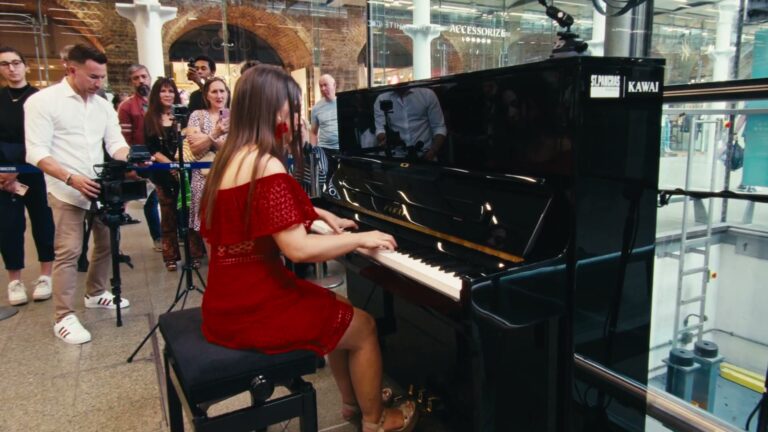
From the studio
A year of content, filmed in one day.
Kawai UK needed 104 films and had the budget for one filming day. We wrote every script first, then filmed all 104 in eight rooms with two crews.