3rd December 2024
Last updated: 8 May 2026 · By Luke Lv, Director, Lumira Studio
Visual storytelling is the deliberate use of imagery, motion, and sequence to convey meaning that words alone cannot. Done well, it makes complex ideas land instantly and emotional moments hit harder. Done poorly, it is decorative footage that looks pretty but communicates nothing. The difference is intentional structure: every visual choice serving a specific story job.
What visual storytelling is, and what it is not
Visual storytelling is not “more cinematic shots”. It is not “better music”. It is the discipline of structuring a sequence of images so that the viewer absorbs the meaning without needing it spelled out.
The strongest visual storytelling does three things:
- Shows the change. The viewer sees the before and the after. The transformation is the story.
- Trusts the viewer. Subtext, suggestion, and inference do more work than narration. The audience fills in the gaps.
- Anchors in specifics. One specific image of one specific moment carries more weight than ten generic shots.
The principles that hold across visual stories
1. Open with the strongest image
The first frame sets the rest. Whatever the most compelling image in the piece is, that should be the open or near-open. Building toward it for 30 seconds wastes the viewer’s attention.
2. Show change over states
A static image of “good” is forgettable. The journey from “broken” to “fixed”, “before” to “after”, “alone” to “together” carries the meaning. Story is movement.
3. Cut on motion or revelation
Cuts that land on a movement, a reveal, or a moment of recognition feel intentional. Cuts placed arbitrarily feel ragged.
4. Use the rule of thirds for visual weight
Subjects placed deliberately within the frame (typically along the thirds-grid intersections) carry more visual weight than centred ones. The eye knows where to go.
5. Match audio to image
Music tempo and tone shape how images read. The same shot under different music tells a different story. The pairing is part of the storytelling.
Patterns that work in B2B visual storytelling
| Pattern | Use for | Example structure |
|---|---|---|
| Before / after | Customer transformation, product impact | Show the problem → introduce the change → show the outcome |
| A day in the life | Recruitment, founder content | Morning to evening through the protagonist’s day, with key moments held longer |
| Origin story | Brand films, founder pieces | The specific moment the company started → the path → today |
| Process reveal | Service demonstrations, behind-the-scenes | Stage by stage through the work, with detail shots and human moments |
| One question, multiple voices | Thought leadership, customer roundups | Same question put to several people, edit creating a layered answer |
Writing visual stories
The strongest visual stories are designed before they are filmed. Three disciplines:
- Two-column scripts. Spoken word in one column, visual direction in the other. Forces the writer to consider what the viewer will see, not just hear.
- Storyboarding key beats. The hook, the climax, the resolution. Sketches do not need to be artistic; they need to communicate the visual idea.
- Identifying the one image that anchors the story. The image that, if everything else were removed, would still carry the meaning. Build the rest of the visual around it.
What undermines visual storytelling
- Decorative B-roll. Pretty footage that does not relate to the story dilutes the actual story.
- Over-explaining. Narration that describes what the viewer is already seeing is redundant.
- Music doing all the emotional work. If the visuals are not earning the emotion, the music will not save them.
- Generic stock footage. Visible stock signals “we did not film this properly”. Even one shot of stock undermines the rest.
- Cuts that do not serve the story. Every cut should answer “what does this give me that the last shot did not”. Decoration cuts come out.
Frequently asked questions
What is visual storytelling?
Visual storytelling is the deliberate use of imagery, motion, and sequence to convey meaning that words alone cannot. It includes structuring shots, pacing cuts, and pairing visuals with sound to create a story the viewer absorbs without needing it spelled out.
How do I make visual storytelling work in marketing video?
Open with the strongest image, show change rather than static states, cut on motion or revelation, place subjects deliberately in the frame, and pair audio to image consciously. Plan the visual story before filming with two-column scripts and storyboards of key beats.
What makes a video visually compelling?
An anchoring image that carries the story, intentional structure (before/after, journey, reveal), specific imagery rather than generic shots, edit pacing that earns each cut, and audio choices that support the visual register. None of these require expensive production; they require deliberate planning.
What is the difference between visual storytelling and just shooting good footage?
Good footage is technically competent. Visual storytelling is technically competent footage organised around a clear narrative goal. The difference is structure: every shot has a job, every cut serves the story, every visual choice supports a specific meaning.
How do I plan visual storytelling before a shoot?
Two-column scripts (spoken word and visual direction together), storyboards of the key beats (hook, climax, resolution), and identification of the single anchoring image that the story is built around. The plan becomes the shoot list and the editing reference.
Does Lumira Studio specialise in visual storytelling?
Yes. Visual storytelling is at the core of how we produce corporate, brand, customer story, and event video. We treat the visual narrative as the primary deliverable, with production craft (lighting, audio, edit) in service of the story rather than the other way round.
From the studio
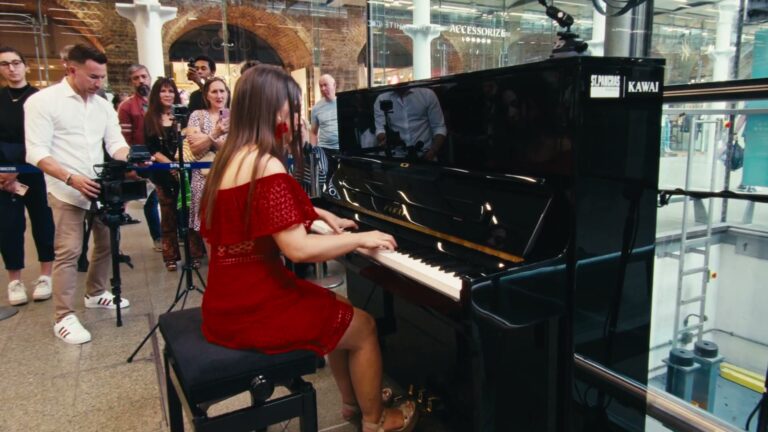
A year of content, filmed in one day.
Kawai UK needed 104 films and had the budget for one filming day. We wrote every script first, then filmed all 104 in eight rooms with two crews.