26th September 2026
A call sheet is the one document everybody on a shoot reads the night before. If it’s done properly, nobody rings you at seven in the morning to ask which entrance, where to park, or when they’re actually needed.
We run small corporate and marketing shoots, usually one or two days, and this is how we write ours.
What is a call sheet?
It’s the plan for a single shoot day, sent to everyone with a reason to be there: the crew, the people on camera, the client, and anyone dropping off or collecting kit. It tells them where to go, what time to arrive, what happens in what order, and who to ring if something goes wrong.
The script and the shot list cover what gets said and what gets filmed. The call sheet covers the logistics that let both happen.
On a film or TV drama it can run to several pages and is usually put together by the second assistant director. On a business shoot it’s normally one or two pages, written by the producer or whoever is running the day. On a small crew that’s often the director too.
What goes on ours
Here’s a made-up shoot to show it: a customer story film for a small coffee roaster, filmed at the roastery in the morning and at their café in the afternoon. The business and the details are fictional, for illustration.
The top of the sheet
Customer story film · Client: Northgate Roasters · Tuesday 13 October 2026 · Day 1 of 1
Version 2, sent 18:10 the evening before
Unit call 07:45 · First shot 08:45 · Lunch 12:45 · Wrap 17:30
Forecast (checked 18:00): dry, cloud clearing after 11:00. Sunset 18:13.
Producer on the day: [name, mobile]
Most people only ever read this block, so it carries the date, the key times and one number to ring.
The version line is there because call sheets change. Times move and someone drops out, so people need to be able to see which copy they’re holding.
Locations
For each location: the full address and postcode, which door to use, where the van can park, and who meets you. On a real sheet we add a what3words reference for the entrance itself, because the address gets you to the building and not always to the right door.
In our example the café is an eight-minute walk from the roastery, and that walk shows up again in the schedule.
Call times
| Who | Call | Where |
|---|---|---|
| Crew | 07:45 | Roastery yard |
| Head roaster (interview) | 08:15 | Roastery office |
| Client contact | 08:30 | Roastery office |
| Café manager | 14:00 | Café |
A call time is the time you’re due to report at the location given. If someone needs time for make-up, a mic or a quick brief before they’re on camera, that goes in on top, so their call is earlier than the first shot they’re in.
The unit call is the general start time for the crew. Some people may have an earlier call of their own, say a sound recordist rigging a room.
Give everyone their own call time. If you call the interviewee in with the crew, they spend an hour in a corridor watching lights go up, and that isn’t a great start to the day for someone who’s nervous about being filmed anyway.
The shooting schedule
The shooting schedule is the part of the call sheet that sets out the order of the day. We build it in blocks, and every block lists the shot numbers it covers.
| Time | What | Shots |
|---|---|---|
| 07:45 – 08:45 | Unload, light the office for the interview | – |
| 08:45 – 10:15 | Interview, head roaster | 1 – 2 |
| 10:15 – 12:45 | Roastery b-roll: green beans, the roaster, cupping | 3 – 11 |
| 12:45 – 13:30 | Lunch | – |
| 13:30 – 14:15 | Pack down, walk to the café, set up | – |
| 14:15 – 16:00 | Café: counter, a customer order, the manager’s piece to camera | 12 – 19 |
| 16:00 – 16:45 | Exteriors, both buildings | 20 – 22 |
| 16:45 – 17:30 | Pack down, sign out, wrap | – |
The interview is first because, in this example, the head roaster has to be back on the roaster by half ten. Plan round whoever has the least room in their diary.
The move to the café gets 45 minutes. It’s an eight-minute walk, but packing down a lit room and setting up in a busy café takes a lot longer than the walk. A schedule with no line for the move will run late whatever else you do.
The client contact is called for 08:30 so they’re in the room before the interview starts, not walking in halfway through it.
Shot numbers on the schedule
The shot list is its own document, with each shot numbered and a line on what it needs:
| # | Shot | Kit |
|---|---|---|
| 3 | Green beans poured into the hopper, close | Macro lens, slider |
| 4 | The roaster’s hands on the controls | Handheld |
| 5 | Beans dropping into the cooling tray, wide | Tripod |
Putting those numbers on the schedule is what connects the two documents. When the café runs 20 minutes behind, you can see straight away which shots are at risk and agree with the client which ones to drop, while you’re still there to do something about it.
Safety, contacts and site rules
- Emergencies: 999 first. Then the nearest A&E with its full address, the first aider or appointed person for the day, and a number that will actually be answered. Look these up for each location every time rather than copying them from the last job. The call sheet sits alongside your risk assessment and doesn’t replace it.
- Contacts: the producer, the client contact, whoever looks after the location, and any supplier people need to reach, with work numbers where you can. Not every crew member’s personal mobile on a sheet that gets forwarded.
- Site rules: safety gear, anything that mustn’t appear on camera (customer names on screens, an order board on the wall), and anyone with a hard stop.
A full example you can download
The walk-through above is trimmed down to show the thinking. Here is a complete one: the example that loads in our free call sheet template, printed exactly as the template prints it. It is a different made-up shoot, the first day of a two-day founder film for a tool maker.
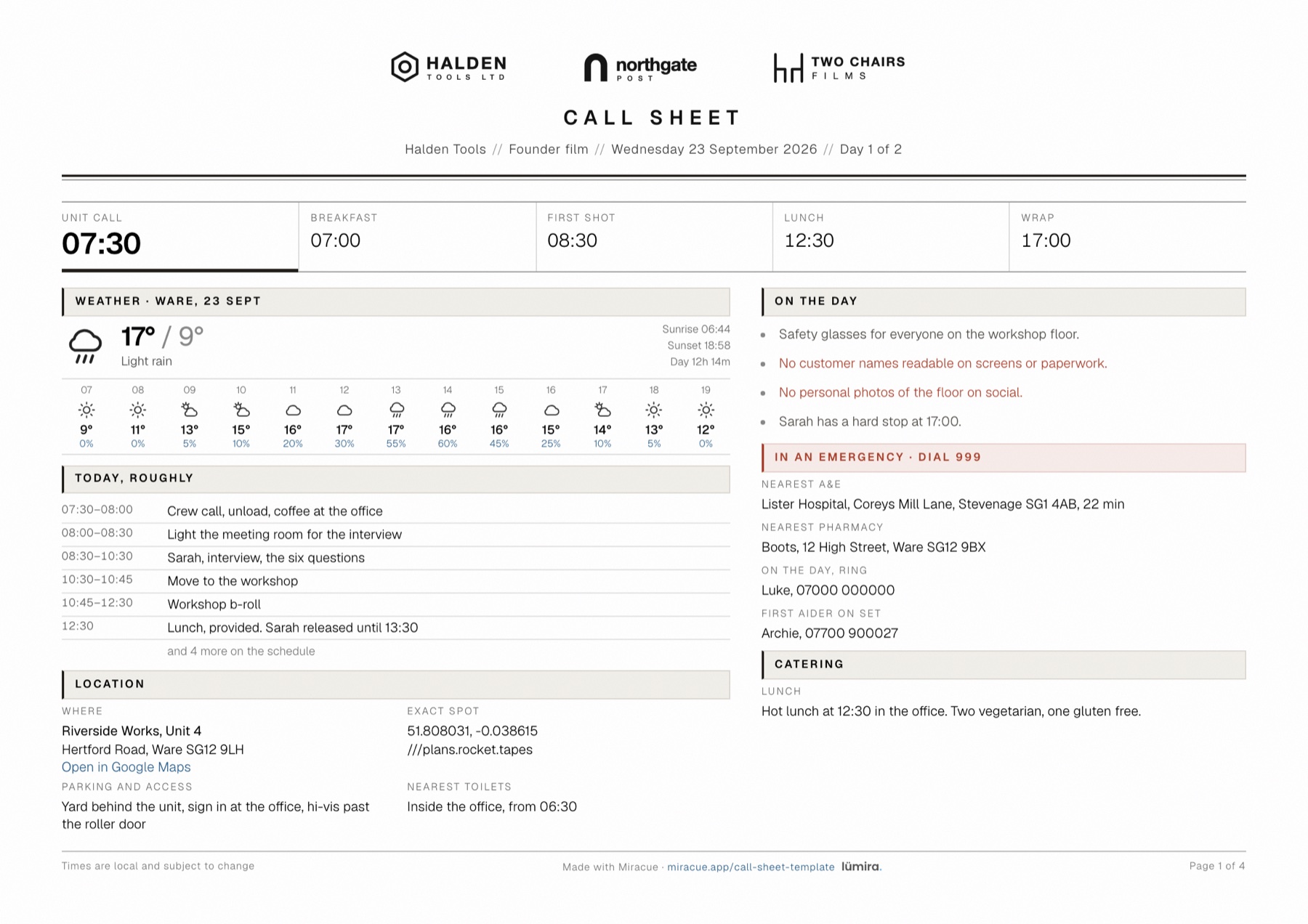
Download the example call sheet (PDF, four pages, 2.8 MB) and the shot list that goes with it (PDF, one page). Page one is the part most people read on the day; the rest carries the detail they come back to.
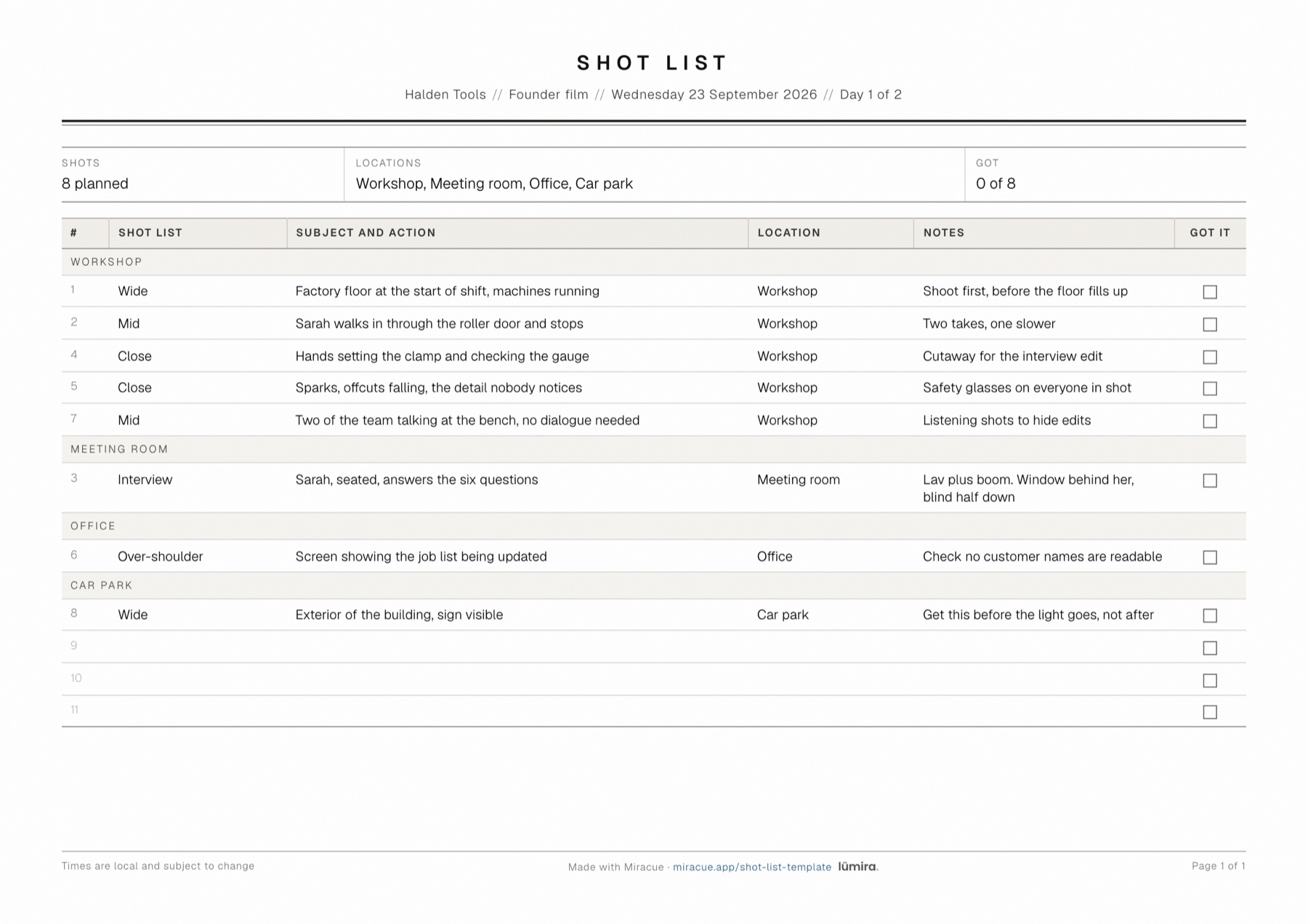
To make your own, open the call sheet template, press Load the example, and type over it.
The problem with the paper copy
A call sheet usually goes out as a PDF and gets printed. On the day, the printed copies get put down somewhere, and by mid-morning the schedule has often moved on from what’s printed. Then everyone asks the one person with the current version, and on a small crew that person is usually behind the camera. It happens all the time.
That’s the reason we built something for our own shoots. Miracue is an app we made at Lumira. It started as a teleprompter, and there’s now a free call sheet template and a separate free shot list template. You don’t need an account, and what you type stays in your browser. The call sheet prints on A4 or US Letter and fills in the weather for the location and date. Both are for making a printable sheet: they don’t send it to anyone or tell you who’s read it, so you still send the PDF yourself. The printout has a small “Made with Miracue” line at the bottom.
What we’re building next is the version for the day itself, planned for Miracue Pro. The call sheet and shot list will be on everyone’s phone in one place. The schedule will update as the day changes, shots get ticked off as they’re filmed, and it will still work without signal. The aim is that the crew, director, producer and client are all looking at the same schedule all day. It isn’t available yet. We’ll update this post when it is.
All the free tools are on one page.
Questions
What should be on a call sheet? The date, the key times, a version number, the weather, each location with its full address and access notes, the shooting schedule, everyone’s call time, the contact numbers people need, emergency details and any site rules.
What does call time mean? The time a person is due to report at the location. Anything they need doing before they’re on camera, like make-up or a mic, is allowed for before their first shot.
What’s the difference between a call sheet and a shooting schedule? The shooting schedule is one part of the call sheet. It’s the order the day runs in, and the rest of the call sheet covers what people need to get there and work safely.
When should a call sheet go out? Send it the evening before, once the times are fixed, and ask everyone to reply to confirm they’ve got it. If people are travelling, send a rough version earlier in the week and put a version number on each one after that.
Who writes the call sheet? On film and TV drama it’s usually the second assistant director. On a business shoot it’s the producer, or whoever is running the day.