8th September 2026
Last updated: 8 September 2026. Written by Luke Lv, Director of Lumira Studio, previously a news agency and television journalist.
A talking head video is a video built around one person speaking, framed from roughly the chest up, either directly to camera or slightly off-axis to an interviewer. It is the format used for founder statements, customer stories, training modules and expert explanation. The value sits in the person and what they know, rather than in the production around them.
It is the format we film most, and it has been part of broadcast and corporate video for as long as either has existed. That is not a lack of imagination on anyone’s part. Little else transfers authority as efficiently. A founder explaining why they started the company, a technical director walking through a problem, a customer describing what changed: none of that lands the same way as a voiceover.
When should you use a talking head video?
The format works when the value is in the person, and the person is credible.
| If the value is in | Use | Why |
|---|---|---|
| A person’s knowledge or credibility | Talking head | Authority transfers from the speaker; nothing else is as efficient |
| A customer’s experience | Talking head interview | A buyer trusts someone like themselves over your marketing team |
| A product working | Product or demo film | The camera belongs on the thing, with a voice underneath |
| A process or a place | Documentary or b-roll led | Showing beats describing when there is something to show |
| A feeling at scale | Brand film | Music, pace and image carry it; one speaker cannot |
It also suits training and internal communication, where a familiar face carries more weight than a polished corporate narrator, and sales enablement, where a two-minute answer to a common objection saves a salesperson repeating themselves forty times.
The other honest caveat: a talking head is only as good as the person in front of the lens. If they do not know the subject, no amount of lighting rescues it.
What makes a good talking head video?
Almost everything that makes a talking head watchable is decided before the camera rolls.
The person is chosen for what they know, not their job title. The most senior person in the room is often not the most convincing one. We would rather film the engineer who has solved the problem three hundred times than the director who can describe it in the abstract.
The lighting supports the face. Off-axis, diffused, matched colour temperature. Most footage that reads as amateur is a lighting problem, not a camera problem. A good camera badly lit looks worse than a modest camera lit properly.
The sound is treated seriously. A dedicated microphone and a room that is not echoing. We work to dialogue levels of around -12dB to -6dB. Audiences forgive an imperfect picture far longer than they forgive imperfect sound. If a budget forces a choice between a better camera and better audio, take the audio.
The framing gives the eye somewhere to rest. Chest up, eyes on the upper third, a background with depth rather than a flat wall directly behind the head. Depth is what stops it looking like a hostage video.
The edit earns its cuts. Every cut should answer what this shot gives that the last one did not. B-roll exists to hold attention across a longer answer, not to decorate.
The part nobody warns you about
The hardest thing about a talking head is not technical. It is that most people are not presenters, and being filmed makes them worse at talking than they normally are.
We watch it happen on nearly every shoot. Someone who explains their work brilliantly in the corridor becomes stiff the moment a lens is pointed at them. They speak in complete corporate sentences they would never use. They try to remember a script word for word, lose it in the third line, and start again. Twenty takes later the energy has gone and the good version was take two.
Two things fix most of it.
The first is the script, and specifically writing it for the ear rather than the page. Short sentences. Active voice. The way that person actually speaks. If a sentence needs a comma to survive, it should be two sentences. Read it aloud before anyone signs it off, and cut whatever makes you run out of breath.
The second is not asking them to memorise it. Give people the words. We use Miracue, a free browser teleprompter we built for our own filming days, so the script sits just under the lens and nobody is spending their attention on recall. It sounds like a small thing. It is the difference between take two and take twenty.
If a filming day covers a lot of pieces, the preparation matters more than the kit. For a training library or a run of short videos, we paste the whole document in and it splits into separate named scripts, one per piece, so the day runs to a plan rather than a search through a Word file between setups.
Talking head video examples
Three films, all built on people talking to camera. This is the point worth making plainly: a great deal of business video is this format, whether or not anyone calls it that.
Timber Connection: the company film
Timber Connection import and supply timber. Thirty-five years of trade, eight-figure turnover, fifteen people, and almost none of it visible online when we started in May 2025. Over the following year we ran six filming sessions and produced more than fifty videos, most of them the chief executive and managing director talking about how the business actually runs. Not claims about service. What they do when a delivery is wrong, and why the person who answers the phone already knows what you buy.
Archwood Group: a practical lesson on yield
The same client, a year on, and a harder subject. Timber Connection have supplied Archwood Group and its Richard Burbidge brand for more than twenty years. By matching the timber more closely to the manufacturing process, they helped lift yield in key areas from around 60% to around 80%, with less waste and less machine downtime. That is a technical story with no obvious pictures, and it works because the people who did it explain it themselves. The case study was published by Timber Development UK and in Supplying Timber, so the yield figures are on the record independently of us.
Delaware North: the Signature Chef Series
In May 2026, Delaware North and Wembley put a Michelin-starred chef in charge of a concessions menu for the Emirates FA Cup Final. We made the first episode of the series: a highlight film led by interviews with the chefs, Andrew Wong and Calum Franklin.
It is also the clearest example of why preparation matters more than kit. The chefs’ schedules were full from the moment we arrived, and we needed both of them at once. The slot came with fifteen minutes left before we had to clear the room. Fifteen minutes, two chefs, and the interviews were the part the whole film rested on. Everything we had gathered while waiting is what gave the edit somewhere to go.
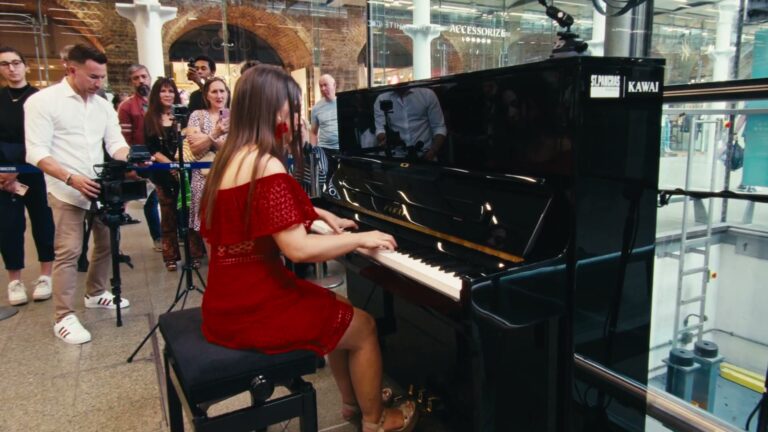
Two more worth mentioning without the film. For Corps Security, the oldest security company in England, the material worth filming turned out to be what they treated as internal housekeeping: how veterans are brought back into work, the charities they fund, the wage commitment. They took the first film into a sales meeting and told us afterwards that a customer in the room was in tears by the end. And for Kawai UK we planned a full year of content into a single filming day: 104 scripts written in advance, one building with eight rooms so a location could hold eight setups, two crews working in parallel. That is only possible because every piece was decided before anyone arrived.
How long should a talking head video be?
As long as it stays interesting and no longer. These are the lengths we work to, rather than industry rules:
| Where it runs | Length | Why |
|---|---|---|
| Social and paid | 60 to 90 seconds | The opening seconds decide whether the rest is watched |
| Website or sales conversation | 2 to 3 minutes | Long enough for one argument, short enough to send |
| Training, one learning point | 3 to 5 minutes | Longer, and the point tends to arrive after attention has gone |
| Anything covering four topics | A series, not one film | Attention does not survive four subjects in one sitting |
What we would tell you before booking one
Film more than one thing while the lights are up. The cost of a filming day sits in the planning, the travel, the crew and the setup. Once everybody is there and the room is lit, a second and third piece cost very little more than the first. A single talking head from a full day is the most expensive way to buy one.
Decide what happens after somebody watches it. A talking head with nowhere to go is a nice film and nothing else.
And be honest about who should be in front of the camera. The right person, prepared properly and given their words, will outperform a better-lit version of the wrong one every time.
Frequently asked questions
What does talking head mean in video?
It means a shot of a person speaking to camera, framed from roughly the chest up, with the speaker as the entire subject. The term comes from broadcast, where it described an interview shot carrying no accompanying footage.
What is an example of a talking head video?
A founder explaining why the company exists, a customer describing a result, a trainer walking through a procedure, or an expert answering one question. The three films above are all working examples produced for clients.
Are talking head videos still effective?
Yes, and they remain one of the most common formats in business video, because the value is in the credibility of the speaker rather than in production complexity. They fail when the speaker does not know the subject, not because the format is tired.
How much does a talking head video cost?
It depends far more on the day than on the format, because the cost sits in planning, travel, crew and setup rather than in the shot itself. A conference or event depends on crew size and how much content comes out of it. Once the room is lit and everyone is there, a second and third piece cost very little more than the first, which is why filming one piece from a full day is the most expensive way to buy one. Book a discovery call and we will price it to your brief.
Do you need a teleprompter for a talking head video?
Not always, but it helps anyone who is not a presenter. Asking someone to memorise a script usually costs more takes than it saves. Putting the words under the lens keeps their attention on delivery.
If you are planning a talking head video and want a straight answer on whether it is the right format, book a discovery call. No obligation.
From the studio
A year of content, filmed in one day.
Kawai UK needed 104 films and had the budget for one filming day. We wrote every script first, then filmed all 104 in eight rooms with two crews.